Section 1 of 13
Introduction
Introduction
TABLE OF CONTENTS Section Page 1 Introduction. . . . . . . . . . . . . . . . . . . . . . . . . . . . . . . . . . . . . . . . . . . . . . . . . . . . . . . . . . . . . 1-1 1.1 Commercial Motor Vehicles (CMV). . . . . . . . . . . . . . . . . . . . . . . . . . . . . . . . . . . . . . . . 1-1 1.2 Commercial Driver License (CDL) and Commercial Learner Permit (CLP) Classes, Endorsements & Restrictions. . . . . . . . . . . . . . . . . . . . . . . . . . . . . . . . . . . . . 1-1 1.3 Commercial Driver License and Commercial Learner Permit Requirements. . . . . . . . . . . 1-3 1.4 Commercial Driver License Tests. . . . . . . . . . . . . . . . . . . . . . . . . . . . . . . . . . . . . . . . . . 1-9 1.5 Additional Requirements For Bus Drivers. . . . . . . . . . . . . . . . . . . . . . . . . . . . . . . . . . . 1-10 1.6 Driver Disqualifications . . . . . . . . . . . . . . . . . . . . . . . . . . . . . . . . . . . . . . . . . . . . . . . . . . 1-10 1.7 Other Commercial Privilege Rules . . . . . . . . . . . . . . . . . . . . . . . . . . . . . . . . . . . . . . . . . 1-13 1.8 International Registration Plan and International Fuel Tax Agreement. . . . . . . . . . . . . 1-14 2 Driving Safely. . . . . . . . . . . . . . . . . . . . . . . . . . . . . . . . . . . . . . . . . . . . . . . . . . . . . . . . . . . . 2-1 2.1 Vehicle Inspection. . . . . . . . . . . . . . . . . . . . . . . . . . . . . . . . . . . . . . . . . . . . . . . . . . . . . . 2-1 2.2 Basic Control of Your Vehicle . . . . . . . . . . . . . . . . . . . . . . . . . . . . . . . . . . . . . . . . . . . . . 2-11 2.3 Shifting Gears. . . . . . . . . . . . . . . . . . . . . . . . . . . . . . . . . . . . . . . . . . . . . . . . . . . . . . . . . 2-12 2.4 Seeing. . . . . . . . . . . . . . . . . . . . . . . . . . . . . . . . . . . . . . . . . . . . . . . . . . . . . . . . . . . . . . . 2-14 2.5 Communicating. . . . . . . . . . . . . . . . . . . . . . . . . . . . . . . . . . . . . . . . . . . . . . . . . . . . . . . . 2-16 2.6 Controlling Speed. . . . . . . . . . . . . . . . . . . . . . . . . . . . . . . . . . . . . . . . . . . . . . . . . . . . . . 2-19 2.7 Managing Space. . . . . . . . . . . . . . . . . . . . . . . . . . . . . . . . . . . . . . . . . . . . . . . . . . . . . . . 2-22 2.8 Seeing Hazards. . . . . . . . . . . . . . . . . . . . . . . . . . . . . . . . . . . . . . . . . . . . . . . . . . . . . . . 2-25 2.9 Distracted Driving . . . . . . . . . . . . . . . . . . . . . . . . . . . . . . . . . . . . . . . . . . . . . . . . . . . . . . 2-28 2.10 Aggressive Drivers/Road Rage. . . . . . . . . . . . . . . . . . . . . . . . . . . . . . . . . . . . . . . . . . 2-29 2.11 Driving at Night . . . . . . . . . . . . . . . . . . . . . . . . . . . . . . . . . . . . . . . . . . . . . . . . . . . . . . . 2-31 2.12 Driving in Fog . . . . . . . . . . . . . . . . . . . . . . . . . . . . . . . . . . . . . . . . . . . . . . . . . . . . . . . . 2-33 2.13 Driving in Winter . . . . . . . . . . . . . . . . . . . . . . . . . . . . . . . . . . . . . . . . . . . . . . . . . . . . . . 2-33 2.14 Driving in Very Hot Weather. . . . . . . . . . . . . . . . . . . . . . . . . . . . . . . . . . . . . . . . . . . . . 2-35 2.15 Railroad-Highway Crossings. . . . . . . . . . . . . . . . . . . . . . . . . . . . . . . . . . . . . . . . . . . . 2-37 2.16 Mountain Driving. . . . . . . . . . . . . . . . . . . . . . . . . . . . . . . . . . . . . . . . . . . . . . . . . . . . . . 2-39 2.17 Driving Emergencies. . . . . . . . . . . . . . . . . . . . . . . . . . . . . . . . . . . . . . . . . . . . . . . . . . 2-41 2.18 Antilock Braking Systems (ABS). . . . . . . . . . . . . . . . . . . . . . . . . . . . . . . . . . . . . . . . . 2-44 2.19 Skid Control and Recovery. . . . . . . . . . . . . . . . . . . . . . . . . . . . . . . . . . . . . . . . . . . . . . 2-47 2.20 Crash Procedures. . . . . . . . . . . . . . . . . . . . . . . . . . . . . . . . . . . . . . . . . . . . . . . . . . . . . 2-48 2.21 Fires. . . . . . . . . . . . . . . . . . . . . . . . . . . . . . . . . . . . . . . . . . . . . . . . . . . . . . . . . . . . . . . 2-49 2.22 Alcohol, Other Drugs, and Driving. . . . . . . . . . . . . . . . . . . . . . . . . . . . . . . . . . . . . . . . 2-51 2.23 Staying Alert and Fit to Drive. . . . . . . . . . . . . . . . . . . . . . . . . . . . . . . . . . . . . . . . . . . . 2-53 2.24 Hazardous Materials Rules For All Commercial Drivers. . . . . . . . . . . . . . . . . . . . . . . 2-55 New York State Department of Motor Vehicles COMMERCIAL DRIVER’S MANUAL
3 Transporting Cargo Safely . . . . . . . . . . . . . . . . . . . . . . . . . . . . . . . . . . . . . . . . . . . . . . . 3-1 3.1 Inspecting Cargo. . . . . . . . . . . . . . . . . . . . . . . . . . . . . . . . . . . . . . . . . . . . . . . . . . . . . . 3-1 3.2 Weight and Balance . . . . . . . . . . . . . . . . . . . . . . . . . . . . . . . . . . . . . . . . . . . . . . . . . . . . 3-2 3.3 Securing Cargo. . . . . . . . . . . . . . . . . . . . . . . . . . . . . . . . . . . . . . . . . . . . . . . . . . . . . . . . 3-3 3.4 Cargo Needing Special Attention . . . . . . . . . . . . . . . . . . . . . . . . . . . . . . . . . . . . . . . . . . 3-4 4 Transporting Passengers Safely. . . . . . . . . . . . . . . . . . . . . . . . . . . . . . . . . . . . . . . . . 4-1 4.1 When the Passenger Endorsement Is Required. . . . . . . . . . . . . . . . . . . . . . . . . . . . . . 4-1 4.2 Vehicle Inspection. . . . . . . . . . . . . . . . . . . . . . . . . . . . . . . . . . . . . . . . . . . . . . . . . . . . . . 4-1 4.3 Loading and Trip Start. . . . . . . . . . . . . . . . . . . . . . . . . . . . . . . . . . . . . . . . . . . . . . . . . . 4-2 4.4 On the Road . . . . . . . . . . . . . . . . . . . . . . . . . . . . . . . . . . . . . . . . . . . . . . . . . . . . . . . . . . 4-4 4.5 After-Trip Vehicle Inspection. . . . . . . . . . . . . . . . . . . . . . . . . . . . . . . . . . . . . . . . . . . . . . 4-5 4.6 Prohibited Practices. . . . . . . . . . . . . . . . . . . . . . . . . . . . . . . . . . . . . . . . . . . . . . . . . . . . 4-5 4.7 Use of Brake-Door Interlocks . . . . . . . . . . . . . . . . . . . . . . . . . . . . . . . . . . . . . . . . . . . . . 4-6 i TABLE OF CONTENTS Section Page New York State Department of Motor Vehicles COMMERCIAL DRIVER’S MANUAL
5 Air Brakes. . . . . . . . . . . . . . . . . . . . . . . . . . . . . . . . . . . . . . . . . . . . . . . . . . . . . . . . . . . . . . . 5-1 5.1 The Parts of an Air Brake System. . . . . . . . . . . . . . . . . . . . . . . . . . . . . . . . . . . . . . . . . 5-1 5.2 Dual Air Brake. . . . . . . . . . . . . . . . . . . . . . . . . . . . . . . . . . . . . . . . . . . . . . . . . . . . . . . . . 5-7 5.3 Inspecting Air Brake Systems. . . . . . . . . . . . . . . . . . . . . . . . . . . . . . . . . . . . . . . . . . . . . 5-8 5.4 Using Air Brakes. . . . . . . . . . . . . . . . . . . . . . . . . . . . . . . . . . . . . . . . . . . . . . . . . . . . . . . 5-10 6 Combination Vehicles. . . . . . . . . . . . . . . . . . . . . . . . . . . . . . . . . . . . . . . . . . . . . . . . . . . . 6-1 6.1 Driving Combination Vehicles Safely. . . . . . . . . . . . . . . . . . . . . . . . . . . . . . . . . . . . . . . 6-1 6.2 Combination Vehicle Air Brakes . . . . . . . . . . . . . . . . . . . . . . . . . . . . . . . . . . . . . . . . . . . 6-5 6.3 Antilock Brake Systems. . . . . . . . . . . . . . . . . . . . . . . . . . . . . . . . . . . . . . . . . . . . . . . . . 6-8 6.4 Coupling and Uncoupling . . . . . . . . . . . . . . . . . . . . . . . . . . . . . . . . . . . . . . . . . . . . . . . . 6-9 6.5 Inspecting a Combination Vehicle. . . . . . . . . . . . . . . . . . . . . . . . . . . . . . . . . . . . . . . . . 6-13 7 Doubles and Triples. . . . . . . . . . . . . . . . . . . . . . . . . . . . . . . . . . . . . . . . . . . . . . . . . . . . . 7-1 7.1 Pulling Double/Triple Trailers. . . . . . . . . . . . . . . . . . . . . . . . . . . . . . . . . . . . . . . . . . . . . 7-1 7.2 Coupling and Uncoupling . . . . . . . . . . . . . . . . . . . . . . . . . . . . . . . . . . . . . . . . . . . . . . . . 7-3 7.3 Inspecting Doubles and Triples. . . . . . . . . . . . . . . . . . . . . . . . . . . . . . . . . . . . . . . . . . . 7-6 7.4 Doubles/Triples Air Brake Check. . . . . . . . . . . . . . . . . . . . . . . . . . . . . . . . . . . . . . . . . . 7-7 8 Tank Vehicles . . . . . . . . . . . . . . . . . . . . . . . . . . . . . . . . . . . . . . . . . . . . . . . . . . . . . . . . . . . . 8-1 8.1 Inspecting Tank Vehicles. . . . . . . . . . . . . . . . . . . . . . . . . . . . . . . . . . . . . . . . . . . . . . . . 8-1 8.2 Driving Tank Vehicles . . . . . . . . . . . . . . . . . . . . . . . . . . . . . . . . . . . . . . . . . . . . . . . . . . . 8-2 8.3 Safe Driving Rules. . . . . . . . . . . . . . . . . . . . . . . . . . . . . . . . . . . . . . . . . . . . . . . . . . . . . 8-3 9 Hazardous Materials . . . . . . . . . . . . . . . . . . . . . . . . . . . . . . . . . . . . . . . . . . . . . . . . . . . . . 9-1 9.1 The Intent of the Regulations . . . . . . . . . . . . . . . . . . . . . . . . . . . . . . . . . . . . . . . . . . . . . 9-3 9.2 Hazardous Materials Transportation – Who Does What. . . . . . . . . . . . . . . . . . . . . . . . 9-3 9.3 Communication Rules. . . . . . . . . . . . . . . . . . . . . . . . . . . . . . . . . . . . . . . . . . . . . . . . . . 9-4 9.4 Loading and Unloading. . . . . . . . . . . . . . . . . . . . . . . . . . . . . . . . . . . . . . . . . . . . . . . . . . 9-12 9.5 Bulk Packaging Marking, Loading and Unloading. . . . . . . . . . . . . . . . . . . . . . . . . . . . . 9-16 9.6 Hazardous Materials – Driving and Parking Rules. . . . . . . . . . . . . . . . . . . . . . . . . . . . . 9-17 9.7 Hazardous Materials – Emergencies . . . . . . . . . . . . . . . . . . . . . . . . . . . . . . . . . . . . . . . 9-20 9.8 Hazardous Materials Glossary . . . . . . . . . . . . . . . . . . . . . . . . . . . . . . . . . . . . . . . . . . . . 9-24 10 School Bus . . . . . . . . . . . . . . . . . . . . . . . . . . . . . . . . . . . . . . . . . . . . . . . . . . . . . . . . . . . . . 10-1 10.1 Danger Zones and Use of Mirrors. . . . . . . . . . . . . . . . . . . . . . . . . . . . . . . . . . . . . . . . 10-1 10.2 Loading and Unloading. . . . . . . . . . . . . . . . . . . . . . . . . . . . . . . . . . . . . . . . . . . . . . . . . 10-3 10.3 Emergency Exit and Evacuation. . . . . . . . . . . . . . . . . . . . . . . . . . . . . . . . . . . . . . . . . 10-7 10.4 Railroad-Highway Crossings. . . . . . . . . . . . . . . . . . . . . . . . . . . . . . . . . . . . . . . . . . . . 10-9 10.5 Student Management . . . . . . . . . . . . . . . . . . . . . . . . . . . . . . . . . . . . . . . . . . . . . . . . . . 10-11 10.6 Antilock Braking Systems . . . . . . . . . . . . . . . . . . . . . . . . . . . . . . . . . . . . . . . . . . . . . . . 10-12 10.7 Special Safety Considerations . . . . . . . . . . . . . . . . . . . . . . . . . . . . . . . . . . . . . . . . . . . 10-13
ii TABLE OF CONTENTS Section Page
11 Pre-Trip Vehicle Inspection Test. . . . . . . . . . . . . . . . . . . . . . . . . . . . . . . . . . . . . . . . 11-1 11.1 Taking the CDL Pre-Trip Inspection Test. . . . . . . . . . . . . . . . . . . . . . . . . . . . . . . . . . . 11-1 11.2 Engine/Cab Inspection (All Vehicles). . . . . . . . . . . . . . . . . . . . . . . . . . . . . . . . . . . . . . 11-1 11.3 External Inspection (All Vehicles) . . . . . . . . . . . . . . . . . . . . . . . . . . . . . . . . . . . . . . . . . 11-4 11.4 School Bus Only . . . . . . . . . . . . . . . . . . . . . . . . . . . . . . . . . . . . . . . . . . . . . . . . . . . . . . 11-8 11.5 Trailer. . . . . . . . . . . . . . . . . . . . . . . . . . . . . . . . . . . . . . . . . . . . . . . . . . . . . . . . . . . . . . 11-9 11.6 Coach/Transit Bus. . . . . . . . . . . . . . . . . . . . . . . . . . . . . . . . . . . . . . . . . . . . . . . . . . . . 11-10 11.7 CDL Vehicle Inspection Memory Aid. . . . . . . . . . . . . . . . . . . . . . . . . . . . . . . . . . . . . . . 11-12 12 Basic Vehicle Control Skills Test. . . . . . . . . . . . . . . . . . . . . . . . . . . . . . . . . . . . . . . 12-1 12.1 Scoring . . . . . . . . . . . . . . . . . . . . . . . . . . . . . . . . . . . . . . . . . . . . . . . . . . . . . . . . . . . . . 12-1 12.2 Exercises. . . . . . . . . . . . . . . . . . . . . . . . . . . . . . . . . . . . . . . . . . . . . . . . . . . . . . . . . . . 12-2 13 On-Road Driving Test. . . . . . . . . . . . . . . . . . . . . . . . . . . . . . . . . . . . . . . . . . . . . . . . . . . 13-1 13.1 Specific Driving Maneuvers. . . . . . . . . . . . . . . . . . . . . . . . . . . . . . . . . . . . . . . . . . . . . 13-1 13.2 Your Overall Performance and General Driving Behavior. . . . . . . . . . . . . . . . . . . . . . 13-5
ALL COMMERCIAL DRIVERS SHOULD READ AND KNOW THE REQUIREMENTS IN SECTION 1 New York State Department of Motor Vehicles COMMERCIAL DRIVER’S MANUAL
iii U.S. Department of Transportation
Driver Training
Federai Motor Carrier Safety Administration
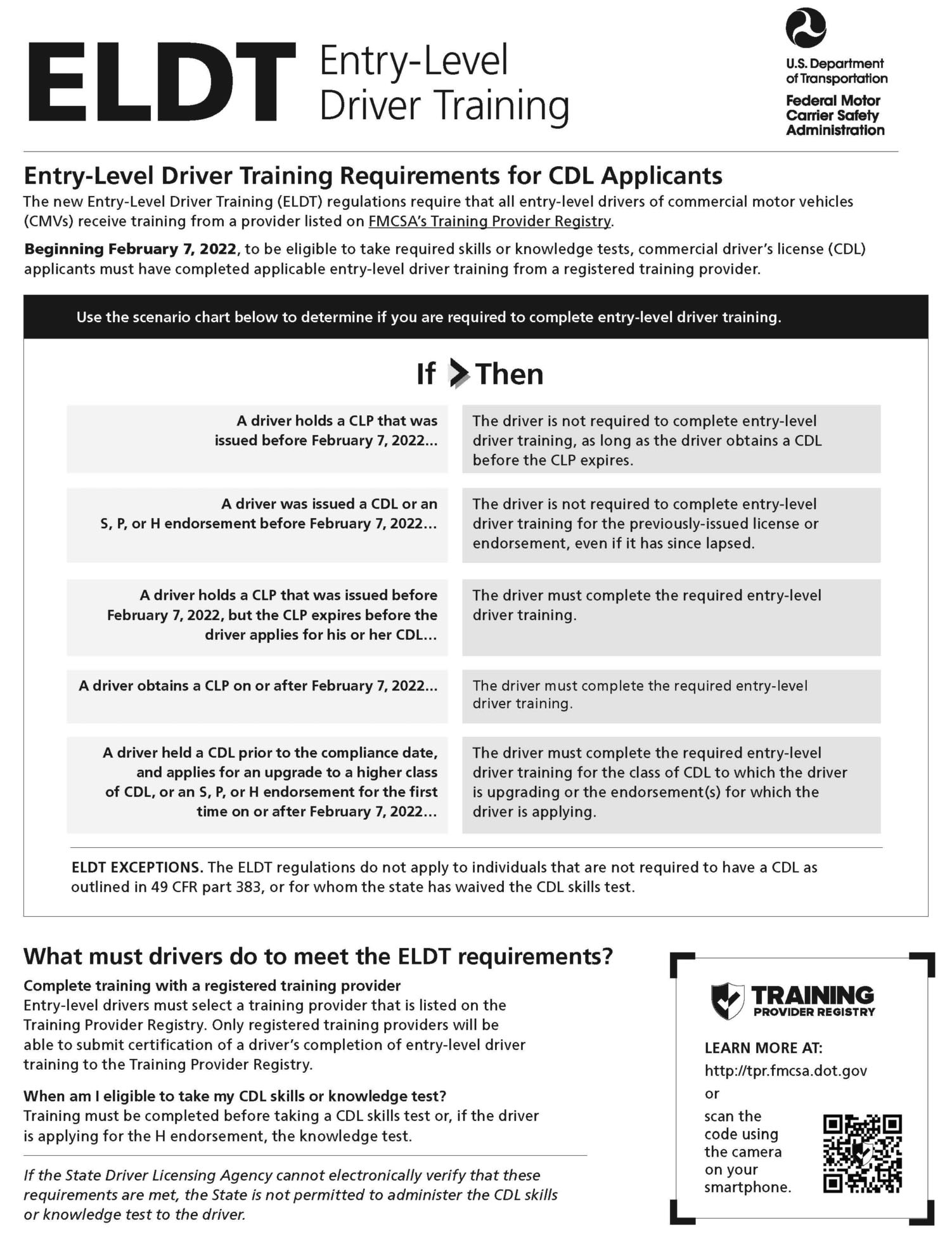
Entry-LevelDriverTrainingRequirementsforCDLApplicants ThenewEntry-LevelDriverTraining(ELDT)regulationsrequirethatallentry-leveldriversofcommercialmotorvehicles (CMVs)receivetrainingfromaproviderlistedonFMCSA'sTrainingProviderRegistry. BeginningFebruary7,2022,tobeeligibletotakerequiredskillsorknowledgetests,commercialdriver'slicense(CDL) applicantsmusthavecompletedapplicableentry-leveldrivertrainingfromaregisteredtrainingprovider.
Usethescenariochartbelowtodetermineifyouarerequiredtocompleteentry-leveldrivertraining.
If>Then AdriverholdsaCLPthatwas issuedbeforeFebruary7,2022... Thedriverisnotrequiredtocompleteentry-level drivertraining,aslongasthedriverobtainsaCDL beforetheCLPexpires.
AdriverwasissuedaCDLoran S,P,orHendorsementbeforeFebruary7,2022... Thedriverisnotrequiredtocompleteentry-level drivertrainingforthepreviously-issuedlicenseor endorsement,evenifithassincelapsed.
AdriverholdsaCLPthatwasissuedbefore February7,2022,buttheCLPexpiresbeforethe Thedrivermustcompletetherequiredentry-level drivertraining. driverappliesforhisorherCDL...
AdriverobtainsaCLPonorafterFebruary7,2022... Thedrivermustcompletetherequiredentry-level drivertraining.
AdriverheldaCDLpriortothecompliancedate, Thedrivermustcompletetherequiredentry-level andappliesforanupgradetoahigherclass ofCDL,oranS,P,orHendorsementforthefirst drivertrainingfortheclassofCDLtowhichthedriver isupgradingortheendorsement(s)forwhichthe driverisapplying. timeonorafterFebruary7,2022...
ELDTEXCEPTIONS.TheELDTregulationsdonotapplytoindividualsthatarenotrequiredtohaveaCDLas outlinedin49CFRpart383,orforwhomthestatehaswaivedtheCDLskillstest.
WhatmustdriversdotomeettheELDTrequirements? Completetrainingwitharegisteredtrainingprovider Entry-leveldriversmustselectatrainingproviderthatislistedonthe TrainingProviderRegistry.Onlyregisteredtrainingproviderswillbe abletosubmitcertificationofadriver'scompletionofentry-leveldriver trainingtotheTrainingProviderRegistry. LEARNMOREAT: http://tpr.fmcsa.dot.gov or Whenam I eligibletotakemyCDLskillsorknowledgetest? TrainingmustbecompletedbeforetakingaCDLskillstestor,ifthedriver scanthe codeusing thecamera onyour smartphone. IsapplyingfortheHendorsement,theknowledgetest.
ELDT
Entry-Level
If the State Driver Licensing Agency cannot electronically verify that these requirements are met, the State is not permitted to administer the CDL skills or knowledge test to the driver.
iv NewYorkStateCommercialDriver'sManualCDL-10(12/21) Pageiv
Commercial Driver License (CDL) and Commercial Learner Permit (CLP) Classes, Endorsements & Restrictions Commercial Driver License and Commercial Learner Permit Requirements Commercial Driver License Tests Additional Requirements For Bus Drivers Driver Disqualifications Other Commercial Privilege Rules International Registration Plan and International Fuel Tax Agreement 1.1 - Commercial Motor Vehicles (CMV) You must have a Commercial Driver License (CDL) or Commercial Learner Permit (CLP) to operate any of the following CMVs: Any single vehicle with a gross vehicle weight rating (GVWR) of 26,001 pounds or more. A trailer with a GVWR of more than 10,000 pounds if the gross combination weight rating (GCWR) is 26,001 pounds or more. GCWR is the GVWR of the power unit plus the GVWR of each vehicle in combination. A vehicle designed to transport 15 or more passengers (excluding the driver) or a vehicle defined as a bus under Article 19-A, Section 509-a of the NYS Vehicle and Traffic Law (VTL). An altered vehicle commonly referred to as a “stretch limousine” that has been modified to carry 9 or more passengers including the driver. Any size vehicle that requires hazardous materials placards or is carrying material listed as a select agent or toxin in 42 CFR part 73.Federal regulations through the Department of Homeland Security require a background check and fingerprinting for the Hazardous Materials endorsement. EXEMPTIONS Drivers of the following vehicles that otherwise meet the definition of a CMV are exempt from the CDL requirement: A vehicle owned and controlled by a farmer that has a GVWR of more than 26,000 lbs and is used to transport agricultural products, farm machinery, or farm products within 150 miles of the farm. Off-road motorized construction equipment such as motor scrapers, backhoes, motor graders, compactors, tractors, trenchers, bulldozers and railroad track maintenance cranes are exempt when operated at a construction site not accessible to the public or when operated on a public road open to unrestricted public travel for limited distances at less than normal highway speeds, provided the equipment is not used in furtherance of a transportation purpose. Such vehicles, when occasionally driven on a public road to reach or leave a construction site must be accompanied by escort vehicles or in some other way separated from the public traffic. Fire and police vehicles engaged in emergency operations in New York State. Military vehicles or combination of vehicles operated by members of the armed forces. INTRODUCTION This Section Covers Commercial Motor Vehicles (CMV)
Personal vehicles (including rental vehicles up to 26,000 lbs GVWR) when operated strictly and exclusively to transport personal possessions or family members for non-commercial purposes.
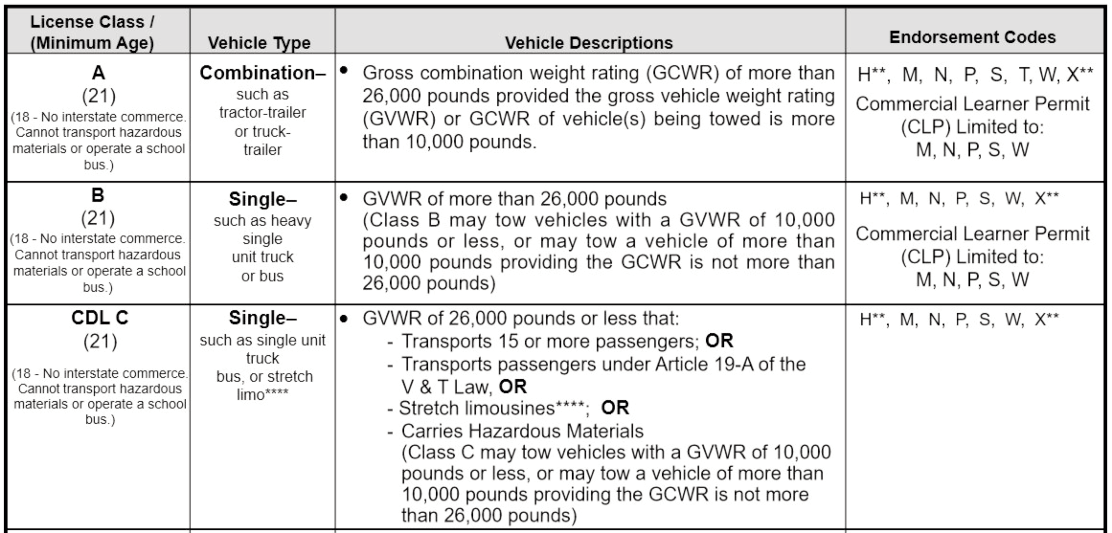
1-1 LicenseClassI (MinimumAge) VehicleType VehicleDescriptions EndorsementCodes A (21) (18-Nointerstatecommerce Combination- •Grosscombinationweightrating(GCWR)ofmorethan 26,000poundsprovidedthegrossvehicleweightrating (GVWR)orGCWRofvehicle(s)beingtowedismore than10,000pounds. H**,M,N,P,S,T,W,X** suchas tractor-trailer CommercialLearnerPermit (CLP)Limitedto: ortruck- Cannottransporthazardous materialsoroperateaschool M,N,P,S,W trailer bus)
B (21) Singlesuchasheavy H**,M,N,P,s,w,X** •GVWRofmorethan26,000pounds (ClassBmaytowvehicleswithaGVWRof10,000 poundsorless,ormaytowavehicleofmorethan 10,000poundsprovidingtheGCWRisnotmorethan 26,000pounds) CommercialLearnerPermit single unittruck (18-Nointerstatecommerce. (CLP)Limitedto: Cannottransporthazardous materialsoroperateaschool orbus M,N,P,S,W bus) Singlesuchassingleunit CDLC •GVWRof26,000poundsorlessthat: -Transports15ormorepassengers:OR -TransportspassengersunderArticle19-Aofthe H**,M,N,P,S,W,X** (21) truck bus,orstretch (18-Nointerstatecommerce V&TLaw,OR -Stretchlimousines**** ;OR -CarriesHazardousMaterials Cannottransporthazardous materialsoroperateaschool limo**** bus.)
(ClassCmaytowvehicleswithaGVWRof10,000 poundsorless,ormaytowavehicleofmorethan 10,000poundsprovidingtheGCWRisnotmore than26,000pounds)

NOTE:Allclassesoflicensesmaybelabeledorareavailableas“Enhanced",whichdoesnotchangeanindividual'sdrivingprivileges(refertoID-44). *Subjecttojuniorlicenserestrictions. **SeeHAZMATManual(CDL-11)forrequirements ***ApplicantswhowantFarm(F)(G)and/orTowTruck(W)endorsementswillcontinuetoreceiveaNon-CDLClicenseatthistime ****Analteredmotorvehiclecommonlyreferredtoasastretchlimousinehavingaseatingcapacityofnineormorepassengerincludingthedriver
| | | Figure 1.2 NEW YORK STATE ENDORSEMENTS | | | |
| F Farm Class A Vehicles R Recreational Vehicles GVWR over 26,000 lbs. G Farm Class B Vehicles S School Bus H Hazardous Materials T Doubles/Triples M Metal Coil W Tow Truck N Tank Vehicles X Tank/Hazmat P Passenger Transport | | F | Farm Class A Vehicles | R | Recreational Vehicles GVWR over 26,000 lbs. |
| | | G | Farm Class B Vehicles | S | School Bus |
| | | H | Hazardous Materials | T | Doubles/Triples |
| | | M | Metal Coil | W | Tow Truck |
| | | N | Tank Vehicles | X | Tank/Hazmat |
| | | P | Passenger Transport | | |
| | | Figure 1.3 NEW YORK STATE RESTRICTIONS | | | |
| | | License restrictions explain your driving limitations. License restriction codes are printed on the front of your license on the line under the “Expiration date” and “E” Endorsement Fields, after the letter “R”. A description of any restrictions you have is printed on the back of your photo license document: A. . . Accel Left of Brake L. . . No Airbrake Equipped CMV ## A1. . . Temporary Visitor M. . . No Class A Passenger VEH ## A2 . . . Problem Driver # N. . . No Class A and B Passenger VEH ## A3. . . Med Cert Exempt ## N1. . . No Vehicle Designed for 15 or More Adult Passengers ## A4. . . Ignition Interlock Device ##### N2 . . . No Vehicle Designed for 8 or More Adult Passengers ## B. . . Corrective Lenses O . . . No Tractor/Trailer CMV ## O1. . . No Tractor Trailer CMV/Truck Not Over 26,000 GVWR ## C. . . Mechanical Aid P. . . No Passengers in CMV Bus ### D. . . Prosthetic Device P1. . . Power Brakes E. . . No Manual Transmission Equipped CMV ## Q. . . Power Steering E1. . . Automatic Transmission R. . . Built Up Seat/Ped/Shoe F . . . Outside Mirrors U. . . Hand-Operated Brake F1. . . Hearing Aid or Full-View Mirror V. . . Medical Variance ## G. . . Daylight Driving Only V1. . . Foot-Oper Parking Brake H. . . Limited to Employment X. . . No Cargo in CMV Tank Vehicle ### I. . . Limited Use Auto MAX 40 MPH X1. . . Full Hand Control I1. . . Limited Use MCY MAX 40 MPH #### Y. . . Shoulder Harness Use I2. . . Limited Use MCY MAX 30 MPH #### Z . . . No Full Airbrake Equipped CMV ## I3. . . Limited Use MCY MAX 20 MPH #### Z1 . . . Wheel Spinner I4. . . Three Wheel MCY #### 4. . . Telescopic Lens 4 K. . . CDL Intrastate Only ## 5. . . No Limtd Access Rds (No operation outside NYS for commerce) | | | |
*** Figure 1.1 NEW YORK STATE CDL CLASS DESCRIPTIONS

*ClassDOnly **CommercialClassOnly *** CommercialLearnerPermitOnly ****MotorcycleClassOnly *****Theinterlockdeviceisnotrequiredinamotorvehicleownedbythelicensee’semployerifthevehicleisusedinthe courseofthelicensee'semployment.Theemployermustconsenttotheuseofthevehiclewithoutthedevice.
1-2 CDL and CLP classes, endorsements and restrictions are based on the type of CMV driven. The type of CMV is determined by the vehicle manufacturer's GVWR (for single vehicles) or GCWR (for combination vehicles), construction or use. (Under the NYS VTL, CMV weight classifications are based on the greater of the following weights: manufacturer's GVWR or GCWR, registration weight, or actual weight of the vehicle(s) and load.) CLP/CDL classes, endorsements and restrictions, therefore, correspond to vehicle weight, construction or use, as shown in Figure 1.1, 1.2 and 1.3 on page 1-2. 1.3 – Commercial Driver License and Commercial Learner Permit Requirements New York State driver licensing standards comply with the federal laws related to commercial driver licenses (CDL) and commercial learner permits (CLP). To get a NYS CDL or CLP you must meet the following standards and requirements: 1.3.1 – Legal Presence Requirement US citizens and Lawful Permanent Residents must provide proof of citizenship or unrestricted Lawful Permanent Residency at a DMV office. Once you have met this requirement in a DMV office you will not be required to prove your legal status again. Applicants from a foreign jurisdiction must provide proof of your legal presence at a DMV office for every transaction. Please refer to form ID-44CDL for a list of all the documents that you may submit as proof of US citizenship, Lawful Permanent Residency, or temporary legal presence. 1.3.2 – Residency Requirement You must be a resident of New York State to be issued a NYS CLP or CDL. One proof of residence is required to apply, transfer, renew, and amend your CLP/CDL. Please refer to form ID-44CDL for a list of all the documents that you may submit as proof of New York State residency. A driver holding a CDL issued by another jurisdiction who moves to New York must apply for a NYS CDL within 30 days after establishing residency. A new resident may apply to exchange a CDL issued by another jurisdiction for a NYS CDL (reciprocity). However, to keep a Hazardous Material (HazMat) endorsement, you must pay the test fee, take and pass the HazMat written knowledge test (a score of 80% is passing), and pay for and pass a background investigation. (See Section 9, Hazardous Materials.) 1.3.3 – Age Requirement Class A, B and C – You must be at least 18 years of age, but if under 21, you can drive a CMV only for intrastate commerce (within New York State), cannot transport students in a school bus, and cannot transport hazardous material.
1.3.4 – Language Requirement
You must be able to read and speak the English language well enough to: converse with other people, understand highway traffic signs and signals in the English language, answer questions from officials, make entries on reports and records, and 1.2 - Commercial Driver License (CDL) and Commercial Learner Permit (CLP) Classes, Endorsements & Restrictions
take skills tests as required for getting your CDL
1-3
NON-EXCEPTED INTERSTATE (NI) • Must be age 21 or over • Must not have a K or A3 restriction • CDL holders with a Medical Variance must have the V restriction • CDL holders with a H or X Endorsement may select this driving type • Current USDOT Medical Examiner’s Certificate required | EXCEPTED* INTERSTATE (EI) • Must be age 18 or over • Must engage only in “Excepted Operation” • Must have an A3 restriction • Must not have a K or V restriction • Must not have H or X endorsement • Medical Examiner’s Certificate Not required * See section 1.3.6 for excepted driving types
NON-EXCEPTED INTRASTATE (NA) • Must be age 18 or over • Must have a K restriction • Must not have an A3 restriction • CDL holders with a Medical Variance must have the V restriction • CDL holders age 21 or over with an H or X Endorsement may select this driving type • Current USDOT Medical Examiner’s Certificate required | EXCEPTED* INTRASTATE (EA) • Must be age 18 or over • Must engage only in “Excepted Operation” • Must have the K and A3 Restrictions • Must not have V restriction • Must not have a H or X endorsement • Medical Examiner’s Certificate Not required * See section 1.3.6 for excepted driving types
Figure 1.4 Self-certification driving types “Interstate” commerce is when you drive a CMV:
- • From one state to another or a foreign country;
- • Between two places within New York State but, during part of the trip, the CMV crosses into another state or foreign country; or
- • Between two places within New York State, but the cargo is part of a trip that began or will end in another state or foreign country. 1.3.5 – Self-Certification Requirement “Intrastate” commerce is when you drive a CMV only within New York State and you do not meet any of the descriptions above for interstate commerce. 1-4 If you self-certify to a Non-Excepted (NA or NI) driving type, the federal government requires you to have a medical examination in order to detect physical or mental conditions that may affect your ability to operate a motor vehicle safely. The examination requirements are found in the U.S. Department of Transportation’s (USDOT) Federal Motor Carrier Safety Administration Regulations under 49 CFR Part 391. The USDOT medical exam covers 13 areas that directly relate to the ability to drive safely. You must pass the USDOT medical examination, and receive a USDOT Medical Examiner’s Certificate. When completing an MV-44 application to apply for, amend or renew a NYS CLP or CDL, if you certify that you have a current, valid Medical Examiner’s Certificate you must provide a copy of your certificate to the DMV in order prove you meet this standard, if one is not already on file. If your Medical Examiner’s Certificate indicates that it must be accompanied by a waiver/exemption or Skills Performance Evaluation (SPE) Certificate, a valid FMCSA variance of the same type indicated on your medical certificate must be on file with the DMV. Your CLP or CDL will not be issued, renewed, or amended if you do not present, or have on file, valid medical documentation. Note: The physical examination conducted just for bus drivers who are subject to Article 19-A of the NYS Vehicle and Traffic Law does not meet the requirements of Part 391 of the Federal Motor Carrier Safety Regulations, unless the federal medical standards, procedures and forms were used and you received a “Medical Examiner’s Certificate”. WHAT IS A MEDICAL EXAMINER’S CERTIFICATE? The USDOT Medical Examiner’s Certificate is attached to the Medical Examination Report, which is completed by a Certified Medical Examiner from the Federal Motor Carrier Safety Administration’s (FMCSA) National Registry of Certified Medical Examiners. All Medical Examiner’s Certificates issued on or after May 21, 2014 must be issued by a Certified Medical Examiner and must contain the Medical Examiner’s National Registry Number. If you pass the exam, the medical examiner should complete the certificate and give it to you to show that you passed. You must present a copy of your certificate to the DMV where it will be kept on file until it expires. Prior to the expiration date of your certificate on file, you must provide an updated Medical Examiner’s Certificate to the DMV. Medical Examiner’s Certificates will only be accepted at your local DMV when submitting an application for an original, amended or renewal of a NYS CDL. If you are not conducting one of those transactions, you must mail or send your certificate to the Medical Certification Unit of the DMV. NYS Department of Motor Vehicles Medical Certification Unit PO Box 2601 Albany, NY 12220-0601 Phone #: (518) 474-3603 Fax@: (518) 486-4421 or 486-3260 Email: dmv.sm.CDLMedCertUnit@dmv.ny.gov HOW LONG IS THE MEDICAL EXAMINER’S CERTIFICATE VALID? A USDOT medical exam is normally valid for 24 months. However, your medical examiner may give you a medical examiner’s certificate that expires in less than 24 months in order to monitor a condition, such as high blood pressure, which the examiner wants to check more often than every two years. 1.3.6 – Medical Examination Requirement WHO MAY PERFORM THE MEDICAL EXAM? As of May 21, 2014, only doctors listed on the FMCSA National Registry of Certified Medical Examiners may perform a USDOT medical exam. All USDOT Medical Examiner’s Certificates issued on or after May 21, 2014 must be issued from a Certified Medical Examiner and must contain the Medical Examiner’s National Registry Number. 1-5 http://www.fmcsa.dot.gov/regulations/national-registry/national-registry-certified-medical-examiners *Important Reminder: It is the responsibility of the CLP or CDL holder to submit updated copies of any required medical documentation to the DMV, prior to the expiration date of the medical documentation on file. Failure to maintain current medical documentation with DMV will result in the loss of your commercial driving privilege. 1.3.7 – Medical Examination Exception A medical exam or a USDOT Medical Examiner’s Certificate is not required if you self-certify to an Excepted (EA or EI) driving type. An Excepted driving type (EA or EI) applies to the following types of commercial operation:
- • To transport school children and/or school staff between home and school;
- • As Federal, State or local government employees;
- • To transport human corpses or sick or injured persons;
- • Fire truck or rescue vehicles during emergencies and other related activities;
- • Primarily in the transportation of propane winter heating fuel when responding to an emergency condition requiring immediate response such as damage to a propane gas system after a storm or flooding;
- • In response to a pipeline emergency condition requiring immediate response such as a pipeline leak or rupture;
- • In custom harvesting on a farm or to transport farm machinery and supplies used in the custom harvesting operation to and from a farm or to transport custom harvested crops to a storage or market;
- • Beekeeper in the seasonal transportation of bees;
- • Controlled and operated by a farmer, but is not a combination vehicle (power unit and towed unit), and is used to transport agricultural products, farm machinery or farm supplies (no placardable hazardous materials) to and from a farm and within 150 air-miles of the farm;
- • As a private motor carrier of passengers for non-business purposes;
- • To transport migrant workers, must be age 21 or older.
- • Drivers who obtained their NYS CDL prior to 9/9/1999 are permitted to perform “non-excepted” commercial operation (except when transporting hazardous materials) in NYS only .These drivers must self-certify to EA. 1.3.8 – Application and Written Testing Requirements To get a Class A, B, or C CDL for the first time, to upgrade to a higher Class CDL, or to add a “P” or “S” endorsement to a CDL, you must first obtain a Commercial Learner Permit (CLP) for the proper class and type of vehicle you plan to drive. To obtain the learner permit, you must already have a NYS driver license that is not suspended, revoked or cancelled. You must apply in person at a NYS motor vehicles office*. Appointments are not needed, however, you should contact the office if you have any special needs. Allow three hours to complete all of the processing, including test taking. Plan to arrive no later than three hours before the office’s scheduled closing time. At the motor vehicles office you will: Complete an application form (MV-44), in which you must: provide proof of your legal presence in the U.S. (see form ID-44CDL) provide proof of your NYS residence (see form ID-44CDL); HOW DO I FIND A LICENSED MEDICAL EXAMINER? To find a certified doctor in your area, please visit the Federal website at: list all the states (including the District of Columbia) in which you were licensed to drive over the past 10 years; 1-6 present a copy of your medical examiner’s certificate, if you meet the federal requirements. Show your NYS driver license. Show your Social Security Card, if NYS DMV has no record of your Social Security Number and you are asked to show your card. Pay the fees that cover the application, processing the photo document, and testing. Pass the general knowledge test and any necessary endorsement tests by answering at least 80% of the questions correctly (see section 1.4); you are not allowed to bring anything into the testing room or area except a pencil, and you must present your driver license again before you can take the test(s). Reminder: cell phones are not permitted in any test area at any time. Federally mandated restrictions on CLPS: CLPs issued with a Passenger (P) or School Bus (S) endorsement will automatically get a new federally mandated “No Passengers in DMV Bus” (P) restriction. CLPs issued with a Tank Vehicles (N) endorsement will automatically get a federally mandated “No Cargo in CMV Tank Vehicle” (X) restriction. The P and X restrictions are issued on the CLP only. The CDL that is issued after all required tests have been passed will not have the P or X restrictions. *Locations and hours of NYS Motor Vehicles offices may be found in your local telephone directory, at the NYS DMV web site at www.dmv.ny.gov/offices.htm, or by calling NYS DMV, weekdays (except state holidays) between 8:00 am and 4:30 pm (Eastern Time) at (518) 486-9786. 1.3.9 – Driving With Your Commercial Learner Permit Your commercial driver learner permit allows you to drive a vehicle of the class and type that matches the class and any endorsements of your permit, as long as: your CLP is accompanied by an underlying NYS license. a driver holding a CDL of the same or higher class with the proper endorsements accompanies you at all times; your permit and the supervising driver’s CDL do not have any restrictions that would prohibit driving in the practice vehicle; and you are not transporting any material that requires hazardous material (HazMat) placards or any quantity of material listed as a selected agent or toxin in 42 CFR 73, even when the supervising driver’s CDL has a HazMat endorsement or you yourself hold a lower class of CDL with a HazMat endorsement. 1.3.10 – Skills Testing Requirements certify to the type of commercial operation you perform, or expect to perform; To get your CDL you must pass the skills test in a representative vehicle – one that matches the class, type and use of the CDL you need. Study sections 11, 12 and 13 in this manual for details about the CDL skills test, and practice driving with your learner permit as much as possible until you are confident that you could pass the test. You may schedule your skills test either on-line at www.dmv.ny.gov or by telephone at 1-518-402-2100. You must wait a minimum of 14 days from the date you obtained your CLP before you may take the skills test. It normally takes several weeks from the date that you make your appointment to the date of the test, so schedule your test early. You may also cancel a scheduled skills test on-line or by telephone, but you must cancel your appointment no less than three full business days prior to your scheduled road test date and time. If you cancel later than that you will lose the skills test fee, and must pay the skills test fee again before rescheduling. Additional information for scheduling a skills test can be found on the DMV website mentioned above. 1-7 During the test, if you have or cause a crash, commit any single traffic violation or dangerous action, or lose more than 50 points, you will fail the skills test. If you fail a skills test you may schedule an appointment for the next test date, based on appointment availability. There is no minimum waiting period before retaking the skills test (except that you may take only one test per day), but the next appointment date may be several weeks from the date you make it. You must pay the skills test fee again before you can schedule your next appointment. 1.3.11 – Military Waiver of Skills Test The Regulations of the Commissioner of Motor Vehicles allow a CDL applicant with military experience driving commercial motor vehicles to apply for a waiver of the CDL skills test. To meet the requirements for this waiver, the applicant must: Currently hold a valid NYS driver license or have a valid out-of-state driver license to be exchanged for a NYS driver license Meet all other requirements to qualify for a NYS CDL Be currently regularly employed (or regularly employed within the last 12 months) in a military position (active duty or New York National Guard) that requires operation of a CMV Have operated a CMV of the type that the driver operates (or expects to operate) for at least two years immediately before: The application date, if in active service, or The date of being discharged from the military At a DMV office, the applicant must present: A completed CDL Certification for Military Waiver of Skills Test (form CDL-102), available at www.dmv.ny.gov/forms/CDL102.pdf or any Motor Vehicles office A valid NYS or out-of-state driver license, Medical Examiner’s Certificate (if required), Proof of military service as listed on form CDL-102 You must pass all applicable written tests and pay the written test fee, permit fee and license fee. There is no skills test fee. If all requirements are met, the DMV office will issue your CDL. The class, endorsements and restrictions on your CDL will depend on the type of CMV you operated in the military. For more information see the Explanation of License Classes, Endorsements and Restrictions (form MV-500C). 1.3.12– Alcohol and Drug Testing Requirements Under New York State law, any person who operates a motor vehicle in New York is deemed to have given consent to a chemical test of one or more of the following: breath, blood, urine or saliva, for the purpose of determining the alcoholic and/or drug content of the blood. 1.4 – Commercial Driver License Tests To pass the skills test you must demonstrate that you can inspect and operate the representative vehicle safely and competently, with 50 or fewer points deducted. All individuals who pass a road test will be instructed to wait 1 day before going to DMV to receive their permanent CDL license. To get a CDL, you must pass knowledge and skills tests. The sole purpose of this manual is to help you pass the tests. This manual is not a substitute for a commercial driver training class or program. Formal training is the most reliable way to learn the many special skills required for safely driving a large commercial vehicle and becoming a professional commercial driver. Section 1.4.1, shows the sections of this manual you should study for each particular class of license and for each endorsement. 1-8 You will have to take one or more knowledge tests, depending on what class of license and what endorsements you need. All test questions are multiple-choice; you must choose one correct answer from three choices. The passing score for each commercial driver knowledge test is 80%. If you fail a knowledge test there is no limit to the number of times you can retake it, however, this will be at the discretion of the District Director, Office Manager, County Clerk or Office Supervisor. The General (Core) Knowledge Test is taken by all CLP or CDL applicants. For this test,study Sections 1, 2, 3, 11, 12, and 13 of this manual. When taking any other CDL knowledge test, all test-takers should study Sections 1, 2, 3, 11, 12, and 13 in addition to the section(s) listed below. The other CDL knowledge tests, and the additional sections of this manual that you should study to pass each of them, are: The Combination Vehicles Test, required to drive combination vehicles (Class A CDL); Study Sections 5 and 6 The Doubles/Triples Test, required to pull double or triple trailers; Study Sections 5, 6, and 7 The Hazardous Materials Test, required to haul hazardous materials or waste in amounts that require placarding or any quantity of a material listed as a select agent or toxin in 42 CFR 73. In order to obtain this endorsement, you are also required to pass both a New York State and a Transportation Security Administration (TSA) background check; Study Section 9 The Passenger Transport Test, taken by all bus driver applicants; Study Section 4 The School Bus Test, required to drive a school bus with a GVWR of more than 26,000 lbs or designed to transport 15 or more passengers (excluding the driver); Study Section 10 The Tank Vehicles Test, required to haul a liquid or liquid gas in a permanently mounted cargo tank rated at 119 gallons or more or a portable tank rated at 1,000 gallons or more; Study Sections 6, 8, and 9 The Air Brakes Test, which you must take if your vehicle has air brakes, including air-overhydraulic brakes; Study Section 5 1.4.2 – Skills Test If you pass the required knowledge test(s), you can take the CDL skills test. You must wait a minimum of 14 days from the date you obtained your CLP before you may take the skills test. There are three types of general skills that will be tested: pre-trip vehicle inspection, basic vehicle control, and on-road driving. You must take the skills test in the class and type of vehicle for which you wish to be licensed. Any vehicle that has marked or labeled components cannot be used for the pre-trip vehicle inspection test. Pre-trip Vehicle Inspection. You will be tested to see if you know whether your vehicle is safe to drive. The pre-trip vehicle inspection must be passed before you can proceed to the basic vehicle control skills test. You will be asked to do a pre-trip inspection of your vehicle and explain to the examiner what you would inspect and why. See Section 11 for details. Basic Vehicle Control. You will be tested on your skill to control the vehicle. You will be asked to move your vehicle forward, backward, and turn it within a defined area. These areas may or may not be marked with traffic lanes, cones, barriers, or something similar. The examiner will tell you how each control test is to be done. See Section 12 for details. 1.4.1 – Knowledge Tests On-road Driving Test. You will be tested on your skill to safely drive your vehicle in a variety of traffic situations. The situations may include left and right turns, intersections, railroad crossings, curves, up and down grades, single or multi-lane roads, streets, or highways. The examiner will tell you where to drive. See Section 13 for details. 1-9 All bus drivers in New York State must have CDLs, and employers must determine that the drivers they hire are qualified to drive buses. Furthermore, Article 19-A (Special Requirements For Bus Drivers) of the NYS VTL sets standards for bus drivers. Under this law, employers of bus drivers must: Conduct a background investigation of a new driver’s employment history for the past three years. Obtain driving records from all jurisdictions where the driver worked, lived or had a driver license or learner permit in the past 3 years. Tell drivers about the provisions of Article 19-A. Require that drivers take an initial physical examination and then follow-up exams every two years. Annually review the driving record of each driver to determine if he/she meets the minimum requirements to drive a bus. Annually observe each driver’s defensive driving performance while operating a bus carrying passengers. Give each driver a written or oral examination every two years to test his/her knowledge of the rules of the road, defensive driving practices and laws regulating bus driving in New York State. Give each driver a behind-the-wheel driving test every two years. Subject a driver who fails to provide notification of convictions and accidents to a five working-day suspension, or, if the conviction is for a misdemeanor or felony, a suspension equivalent to the number of working days a driver was not in compliance with the reporting requirements, or five working days, whichever is longer. Additional Requirements For School Bus Drivers. Article 19-A requires that employers of school bus drivers request a criminal history check on each driver based on his/her fingerprints. NYS Education Department (NYSED) regulation further requires that drivers of school buses: Be at least 21 years of age. Take and pass a yearly follow-up physical exam. If a bus driver fails to meet any of the legal or regulatory requirements, the employer must not allow the driver to operate a bus until requirements are met. The Department of Motor Vehicles also disqualifies drivers based on their driving record and criminal history. 1.6 – Driver Disqualifications 1.6.1 – General You may not drive a commercial motor vehicle if you are disqualified for any reason. 1.6.2 – Alcohol, Leaving the Scene of an Accident, and Commission of a Felony It is illegal to operate a CMV if your blood alcohol concentration (BAC) is .04% or more. If you operate a CMV, you shall be deemed to have given your consent to alcohol testing. You will be put out-of-service for 24 hours if you have any detectable amount of alcohol under .04%. You will lose your CLP and/or CDL for at least one year for a first offense for: Driving a CMV if your blood alcohol concentration is .04% or higher. Driving any vehicle under the influence of alcohol. Driving any vehicle while under the influence of a controlled substance. 1.5 – Additional Requirements For Bus Drivers Refusing to undergo blood alcohol testing. 1-10 Committing a felony involving the use of a vehicle. Operating a CMV while your CLP and/or CDL is revoked, suspended, or canceled for prior violations, or if disqualified from operating a CMV, or if convicted for causing a fatality through negligent operation of a CMV, including, but not limited to crimes of vehicular manslaughter or criminally negligent homicide. You will lose your CLP and/or CDL for at least threeyears if the offense occurs while you are operating a CMV that is placarded for hazardous materials. You will lose your CLP and/or CDL for life if convicted a second time for any of the offenses listed above. You will lose your CLP and/or CDL for life if you use a CMV to commit a felony involving controlled substances. 1.6.3 – Serious Traffic Violations Serious traffic violations include: Excessive speeding (15 mph or more above the posted limit) Reckless driving Improper or erratic lane changes Following a vehicle too closely Traffic offenses committed in a CMV in connection with fatal traffic accidents Operating a CMV without first obtaining a CLP or CDL Operating a CMV without a CLP or CDL in the driver’s possession Operating a CMV without the proper class of CLP or CDL and/or endorsement for the specific vehicle being operated or for the passengers or type of cargo being transported Operating a CMV while using a handheld cell phone and/or texting device. You will lose your CLP and/or CDL: For at least 60 days if you have committed two serious traffic violations within a three-year period involving a CMV. For at least 120 days for three serious traffic violations within a three-year period involving a CMV. 1.6.4 – Violation of Out-of-Service Orders If a federal or state inspector judges you or your commercial vehicle to be unsafe during an inspection, they will order you or your vehicle out-of-service. You will lose your CLP and/or CDL if convicted of operating in violation of the out-of-service order: For at least 90 days if you have committed your first violation of an out-of-service order. For at least one year if you have committed two violations of out-of-service orders within a ten-year period. Leaving the scene of an accident without reporting. For at least three years if you have committed three or more violations of out-of-service orders within a ten-year period. 1-11 These violations, while operating a commercial motor vehicle, include violation of a federal, state or local law or regulation pertaining to one of the following six offenses at a railroad-highway grade crossing: For drivers who are not required to always stop, failing to stop before reaching the crossing if the tracks are not clear. For drivers who are not required to always stop, failing to slow down and check that the tracks are clear of an approaching train. For drivers who are always required to stop, failing to stop before driving onto the crossing. For all drivers failing to have sufficient space to drive completely through the crossing without stopping. For all drivers failing to obey a traffic control device or the directions of an enforcement official at the crossing. For all drivers failing to negotiate a crossing because of insufficient undercarriage clearance. You will lose your CLP and/or CDL: For at least 60 days for your first violation. For at least 120 days for your second violation within a three-year period. For at least one year for your third violation within a three-year period. 1.6.6 – Hazardous Materials Endorsement Background Check and Disqualifications If you require a hazardous materials endorsement you will be required to submit your fingerprints and be subject to a background check. You will be denied or you will lose your hazardous materials endorsement if you: Are not a lawful permanent resident of the United States. Renounce your United States citizenship. Are wanted or under indictment for certain felonies. Have a conviction in military or civilian court for certain felonies. Have been adjudicated as lacking mental capacity or are involuntarily committed to a mental health facility as specified in 49 CFR 1572.109. Are considered to pose a security threat as determined by the Transportation Security Administration. Additional information is available at: www.dmv.ny.gov/cdl.htm 1.6.7 – Traffic Violations in Your Personal Vehicle Federal and State rules require a CLP and CDL holder to be disqualified from operating a commercial motor vehicle if the CLP or CDL holder has been convicted of certain types of moving violations in their personal vehicle. This includes: leaving the scene of an accident, violations involving alcohol and/or drugs, and felonies involving a motor vehicle. If your privilege to operate your personal vehicle is revoked, cancelled, or suspended due to violations of traffic control laws (other than parking violations) you will also lose your commercial driving privileges. 1.6.5 – Railroad-Highway Grade Crossing Violations If your privilege to operate your personal vehicle is revoked, cancelled, or suspended due to alcohol, controlled substance, or felony violations, you will lose your CLP and/or CDL for 1 year. If you are convicted of a second such violation in your personal vehicle or CMV, you will lose your 1-12 If your license to operate your personal vehicle is revoked, cancelled, or suspended, you may not obtain a “hardship” license to operate a CMV. 1.7 – Other Commercial Privilege Rules There are other federal and state rules that affect drivers operating CMVs in all states. Among them are: 1.7.1 – Licensing Rules No one can drive a commercial motor vehicle without a CLP or CDL. A court may fine you $75-$300 or put you in jail for breaking this rule. You cannot have more than one license. If you break this rule, a court may fine you $75-$300 or put you in jail and keep your home state license and return any others. If you have a hazardous materials endorsement, you must notify and surrender your hazardous materials endorsement to the state that issued your CDL within 24 hours if: you are convicted, indicted, or found not guilty by reason of insanity in any jurisdiction, civilian or military, for a disqualifying crime listed in 49 CFR 1572.103; you are adjudicated as lacking mental capacity or are involuntarily committed to a mental health facility as specified in 49 CFR 1572.109; or you renounce your U.S. citizenship. All states are connected to one computerized system to share information about CLP and CDL drivers. The states will check driving records and make sure that drivers do not have more than one CLP and CDL. You must be properly restrained by a safety belt at all times while operating a commercial motor vehicle. The safety belt design holds the driver securely behind the wheel during a crash, helping the driver to control the vehicle, and reduces the chance of serious injury or death. If you do not wear a safety belt, you are four times more likely to be fatally injured if you are thrown from the vehicle. 1.7.2 – Employment Rules You must give your employer information on all driving jobs you have held for the past 10 years. You must do this when you apply for a commercial driving job. You must notify your employer within 30 days of conviction for any traffic violations (except parking). This is true no matter what type of vehicle you were driving. You must notify your employer if your license is suspended, revoked, or canceled, or if you are disqualified from driving. CLP or CDL for life. Your employer may not let you drive a commercial motor vehicle if you have more than one license or if your CLP or CDL is suspended, revoked or cancelled. A court may fine the employer up to $5,000 or put him/her in jail for breaking this rule. 1.8 – International Registration Plan and International Fuel Tax Agreement If you operate a CMV in interstate commerce, the vehicle, with few exceptions, is required to be registered under the International Registration Plan (IRP) and the International Fuel Tax Agreement (IFTA). These programs provide for the collection and distribution of vehicle registration fees and fuel use taxes for interstate travel. 1-13 Under the IRP, jurisdictions must register vehicles and audit registrant mileage records. Registrants must apply for IRP registration, provide proper documentation, pay appropriate fees, properly display credentials, maintain accurate and compliant mileage records, and make records available for audit. 1.8.2 - International Fuel Tax Agreement (IFTA) administered by the Department of Taxation and Finance (DTF) IFTA enables interstate carriers to report fuel used and pay fuel use taxes. Under the IFTA, a carrier is issued one set of credentials to travel in all IFTA member jurisdictions. The fuel use taxes collected pursuant to the IFTA are calculated based on the number of miles/ kilometers traveled and the number of gallons/liters consumed in all member jurisdictions. The base jurisdiction will collect and distribute fuel use taxes to other member jurisdictions and perform fuel use tax audits. Carriers must file IFTA quarterly tax returns with the base jurisdiction to report travel and fuel use in all IFTA member jurisdictions. Carriers must retain mileage and fuel records to support their IFTA quarterly tax returns. 1.8.3 – Additional Information and Recordkeeping Requirements Additional information and recordkeeping requirements for the IRP can be obtained from DMV’s IRP Instruction Manual (IRP-8), available under “Business Use Forms” at www.dmv.ny.gov. IRP, Inc. is the official repository for the IRP, and additional information can be found on their website at www.irponline.org There is a training video on their website available in English, Spanish and French. For additional information on IFTA, visit the Department of Taxation and Finance website at http://www.tax.ny.gov/. You will also find useful information at the official IFTA repository at http://www.iftach.org/index.php 1.8.4 - Record Retention for IRP and IFTA For IRP, mileage records supporting IRP registrations must be retained for 6 years. For IFTA, mileage and fuel records supporting IFTA quarterly fuel use tax returns must be retained for 4 years. 1.8.1 - International Registration Plan (IRP) administered by the Department of Motor Vehicles (DMV) 1-14 1-15